

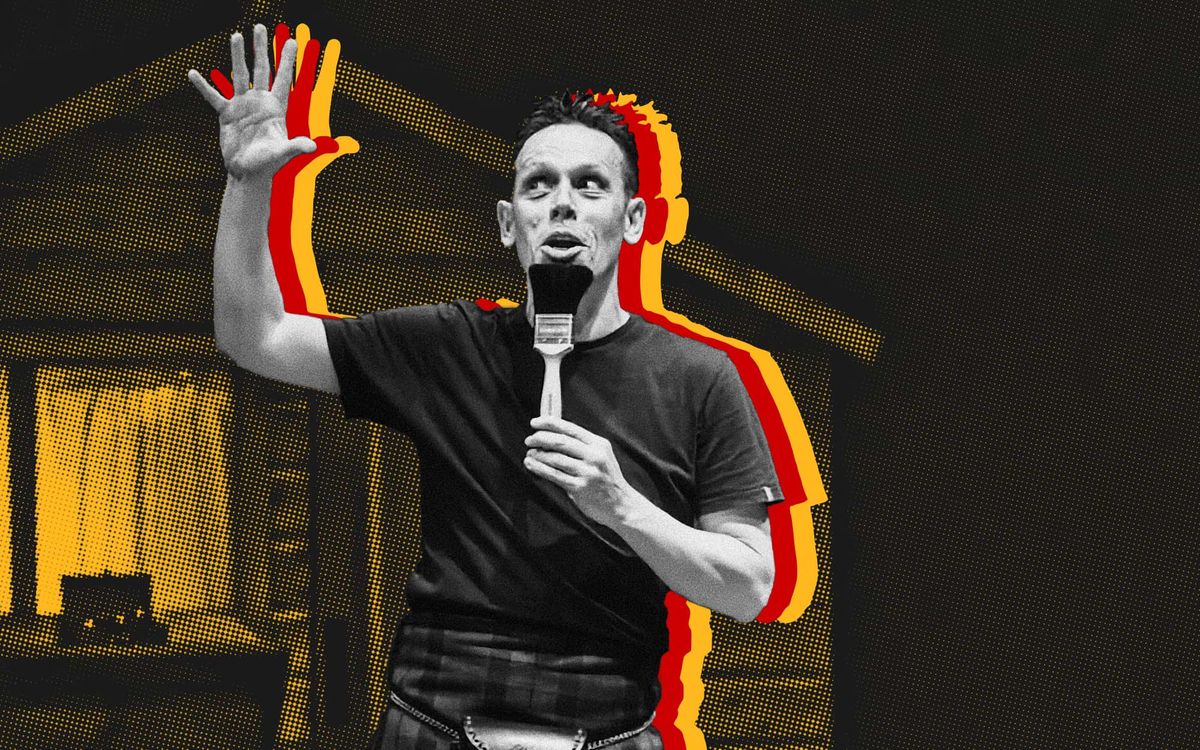
Storyteller Andy Cannon on Mons Graupius, Fittie and the battle’s lost story.
Andy Cannon has spent almost thirty years telling stories, at every scale from a Leith front room to a stadium. He ran a children’s theatre company for the best part of two decades before turning to solo shows built on Scottish history and myth, and in 2014 he worked on the Commonwealth Games opening ceremony. His latest show is rehearsing in the community hall in Fittie, to tell the story of a battle almost nobody in Scotland has heard of.
That show is The Last People on Earth. It centres on a speech that has survived for two thousand years largely by accident: the words the Roman historian Tacitus gave to Calgacus, leader of the tribes who fought Rome at Mons Graupius, somewhere in the North East, around AD 83. It’s the only account we have, and it comes entirely from the side that won.
The Last People on Earth is on at Fittie Community Hall on Saturday 3 October, 7pm to 8.15pm. Tickets are available here.
We spoke to Andy about what it takes to tell a defeated people’s story from inside the victor’s own record, and why a community hall in Fittie is exactly the right place to rehearse it. He also told us the one line from his own life he’d want dug up two thousand years from now.
What made you choose storytelling rather than acting or playwriting?
I’m no stranger to the latter but for me storytelling is the mother of all theatre - get that right and the other two can join in!
You founded Wee Stories Theatre in 1996. Why did you decide to set up a company for children’s stories instead of performing them solo?
To be honest, my background was in traditional theatre and back in the 1990’s solo performances were quite rare so in some ways it was simply that I thought that was the thing to do. I wouldn’t change it though - I worked with many talented people and especially musicians, who I always try to work with if possible, so I don’t aim to do solo shows in the traditional sense - it’s hopefully myself and a hugely talented performing artist, like Wendy Wetherby!
After Wee Stories, your solo work also began reaching towards Scottish history and mythology, with shows like Scota-land and Tales of a Grandson. What made you want to bring an older audience into work that had started out for children?
I wanted to bring adult audiences into the work I was doing in children’s theatre. At Wee Stories we had a strong adult theatre-going following, which really started to grow with ARTHUR, The Story of a King. That gave me the idea to start exploring a broader audience - that said, I really enjoy and appreciate a broad age group in the audience, particularly with evening audiences, 8 and up. I do still create work specifically for children, particularly pre-school and infant primary (something I think all artists should do, a creative treat!).
You were Creative Director of Performance for the 2014 Commonwealth Games opening ceremony. What lessons did you learn from operating at that scale that you still use when working in smaller venues like community halls?
In some ways the lessons were in reverse - working at that scale is only possible if you hold true to the values of working in small venues such as community halls. Working with such a huge cast was a joy - we ran literally hundreds of auditions, workshops and rehearsals, and each one was the only important thing at that moment.
The team I worked with were fantastic and truly inspiring and I have no doubt they would say the same (for example: the choreographers I worked with had a lot of experience working at that scale and had worked on many games, including London 2012, but they would be at their most animated when talking about their “Street Dance” classes in Manchester schools and community halls).
The battle nobody's heard of
The production centres on Mons Graupius, a battle fought in the North East around two thousand years ago, and a speech that’s survived from it ever since. Without giving too much away, what is it about that speech that made you want to build a whole show around it?
I developed the show to find an entertaining and engaging way to do just that: explain Mons Graupius, Calgacus and his famous speech. So my answer to this question is come and see “The Last People on Earth.”
People disagree about where the battle took place. Bennachie is one possible site. Does this uncertainty make the story harder to tell, or does the mystery make the subject more appealing to you?
Much more appealing - the fact that there is uncertainty creates a great starting point.
You’re incorporating local choirs to form a chorus that links the audience to the story. Why did you opt for this method instead of a solo performance for this revival?
I am fascinated with the role of the chorus in classical theatre, particularly their role of being a conduit between the audience and the stage. Writers are never alone - their background, their communities, family etc are always with them and the chorus, for me, in some ways represents them, keeping them honest. With this piece I wanted a local chorus to join me in telling the story/s of an event that has its roots in their land.
How the show comes together
Do you have a particular goal in mind when you start a new project?
Simply to share with an audience something that I think is worthy of their precious time in an engaging and entertaining way.
Give us an idea of the process of creating a show like this. Where does the work begin, and how much of the final performance is written beforehand compared with what is developed during rehearsals with the cast and the choir?
Just about all of my shows begin with a question - sometimes based on geography: why’s that there? or culturally: why is that person, song, play, sport etc so popular? or politically: why are they in charge? How did they get so rich? Why are they poor? Scientifically: how does that work? How would we get there? How could we survive there?
The answers beg a story - often surprising stories - but crucially entertaining and engaging stories. Often my stories are a journey through my ignorance - “The Last People on Earth” began with the question: if this is arguably a nation-defining event in Scotland’s story, why have most people never heard about it?
So in a sense, when creating the piece I simply share where I’m at with other artists and interested parties and invite them along to explore and discover the answers with me.
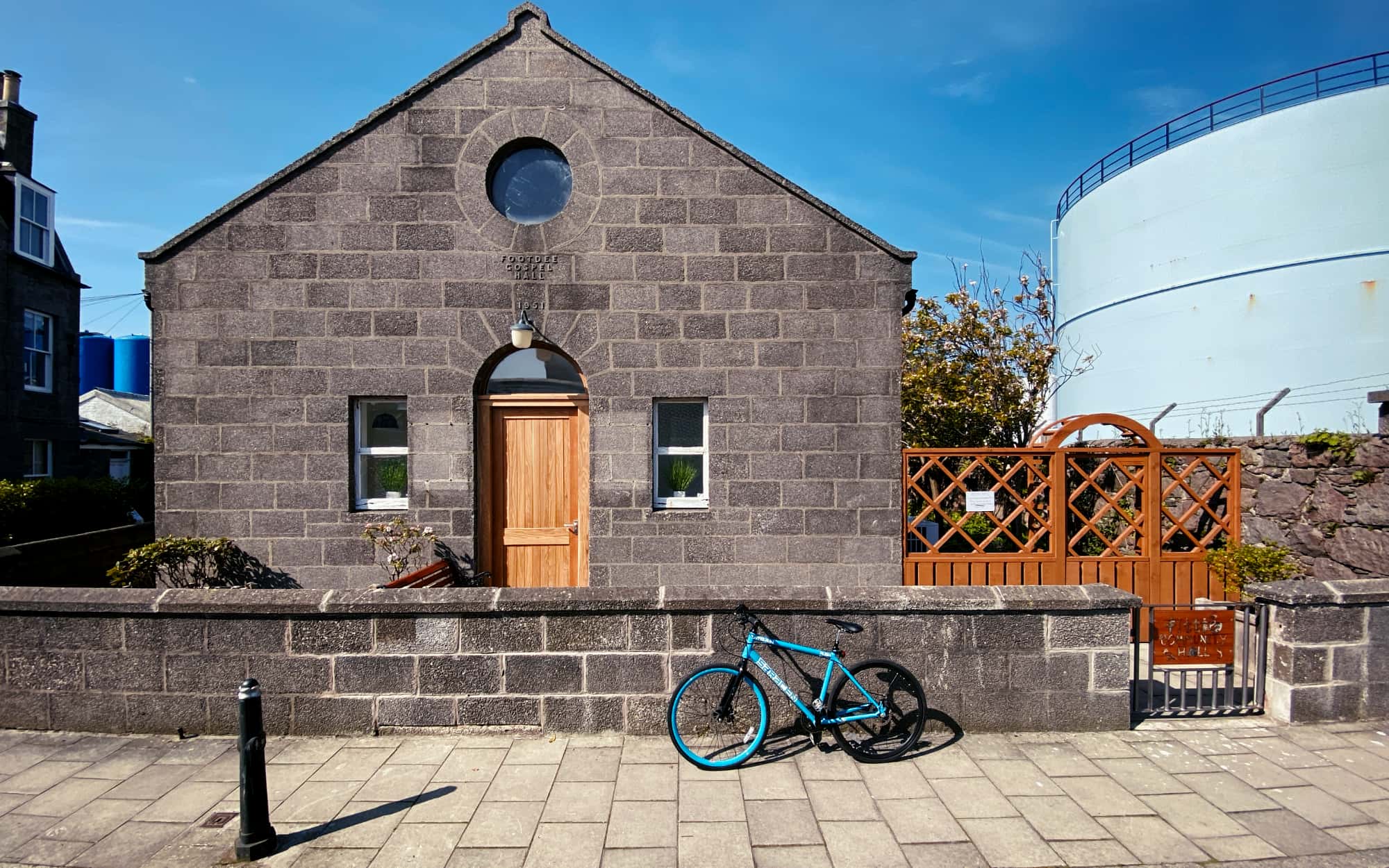
Rehearsals are being held at Fittie Community Hall. How does rehearsing this story in that specific location and with that community influence the work?
Fittie is a quite remarkable community, and a truly inspirational place to create in. Even the very process of travelling to work is a great preparation for creativity - whether walking through the busy dockyards from town or taking the route along the coast from the “windows,” it’s impossible not to have a deep sense of Aberdeen and the North East’s long history and influence over where we now call Scotland.
A spoken story is not captured in writing or on film like other types of work, meaning there is no permanent version to reference later. How do you document a piece like this after a performance, and what criteria do you use to decide if it was successful?
On a purely practical level, I tape my rehearsals and performances so as to have a record of the performance. I then transcribe the recording and it is during this process that the writer in me edits and creates more material. This is also when I channel my inner “dramaturg”, who interrogates and explores the narrative structure and connections.
Regards to its success: for me this has always been based on the intensity of engagement I/we have created. This is difficult to explain as it’s purely instinctive, but when it works, which is more often than not, you know: it’s electric!
You’ve been telling stories to children and adults for twenty-five years. What does storytelling achieve that a history book or a museum panel does not?
The human connection - not with the subject, but with the passion for the subject and why it matters to the teller. Books are great and I’d live in a museum if it was possible! - but storytelling is a conversation. I’m interested in why we engage with history as much as the history itself. Storytelling gives me (and the audience too, hopefully!) the chance to explore the human experience together.
You moved from Leith up to the Moray Coast recently. Has living on that magnificent coastline altered your connection to the landscape and this story?
Continually!
Calgacus is known mainly for one speech. If a single story or quote from your life were discovered two thousand years from now, which would you choose for it to be?
It would be the true story of my holiday with my grandad to Loch Ness to spot Nessie.
I was 10 years old, and after three days of scouring the Loch for the monster we returned home. On our return my Granny asked: “Well, did you see her?” “No,” replied my grandad, “but I think she saw us!”
The Last People on Earth runs at Fittie Community Hall on Saturday 3 October, from 7pm to 8.15pm. Tickets are available here.
Thanks to Andy for taking the time to speak with us, and to Lucy Stroud at Open Road for arranging it. If you’ve got a story of your own you think POST should hear about, get in touch.
Comments ()